 · N Khanna
 Your office types the same order 3 times
Nobody decided this. It happened 1 system at a time, and every purchase was sensible on the day it was made. Here is how to count what it costs, with the arithmetic, so you can run it without us.
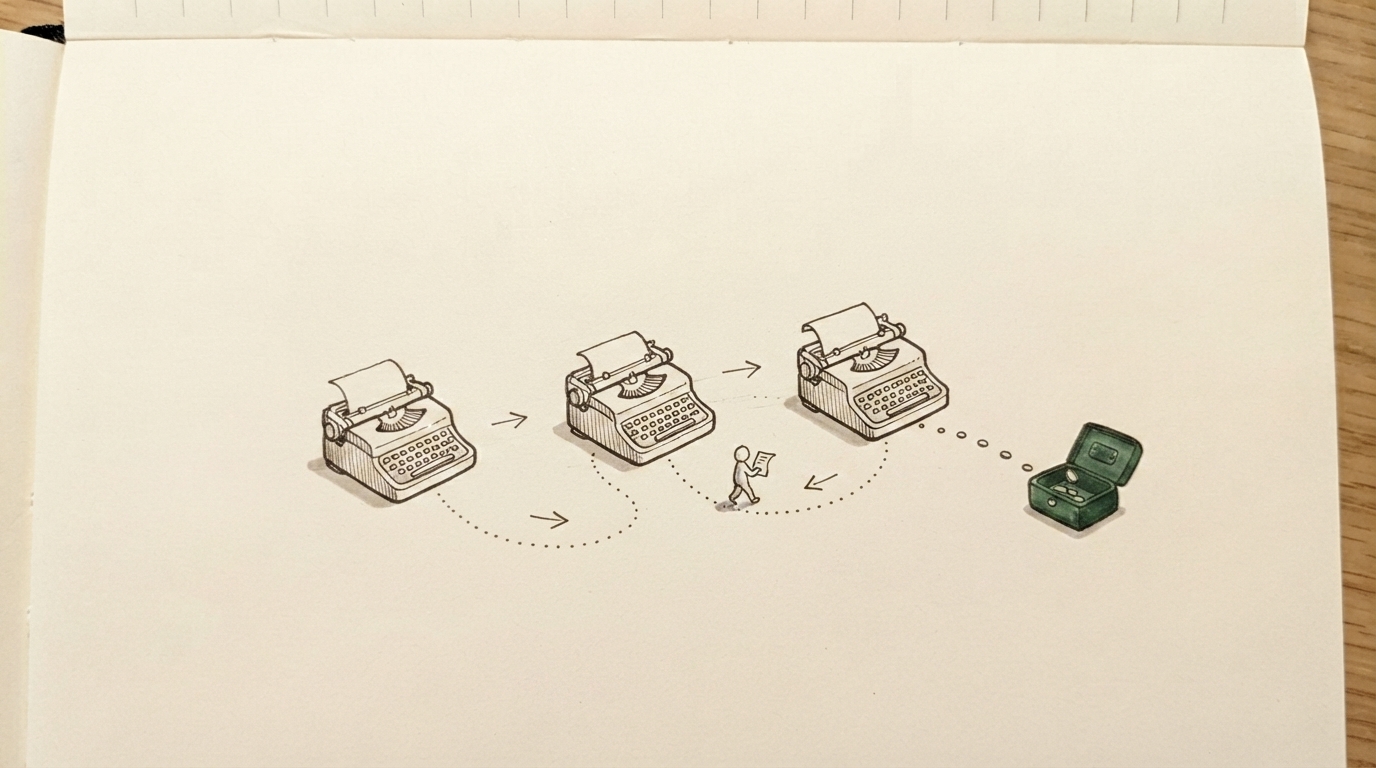
A customer calls on a Tuesday and orders 40 cases.
Somebody types it into the quoting system. When it turns into a real order, somebody types it into the order system. When it ships, somebody types the invoice into the accounting package. 3 screens. 1 order. The same 12 fields every time, and 2 of those 3 typings produce nothing that did not already exist.
Nobody decided this. It happened 1 system at a time over about 9 years, and every one of those purchases was sensible on the day it was made. The systems were never asked to talk to each other, because there was always somebody there who could do it instead.
That somebody is your integration. You are paying a salary to move data between screens.
Walk 1 order and count
Don’t audit the whole company. Take a single order from last week, ideally an ordinary one rather than the disaster everybody remembers, and follow it from the first phone call to the day the cash arrived.
At every screen it touched, write down 2 things. What got typed, and whether that information already existed somewhere else in the building.
The second question is the one that matters. First entry is real work. Anything after that is your business paying a person to be a cable.
Most owners guess 2 systems and find 4. The 2 that surprise people are usually a spreadsheet somebody built years ago that the whole process now depends on, and a shipping portal that needs the address retyped because it won’t accept a paste.
Now put a number on it
Time 1 of each re-typing with a stopwatch. Not an estimate. Estimates on this run low, because the person doing it has stopped noticing.
Then the arithmetic is 4th grade.
That number is only the typing. It doesn’t include the part where somebody walks over to ask which of the 2 records is right.
The cost nobody puts in the spreadsheet
People make mistakes when they copy things. Published work on manual data entry puts the error rate somewhere between 1% and 4% of entries, and the firms publishing it mostly sell software that removes the entry, so treat the top of that range with suspicion.
Take the bottom. At 120 orders a week, 1% is roughly 1 wrong order every week.
A wrong order isn’t a typo. It’s a credit note, a re-ship, a driver going back out, a phone call to a customer who now checks every invoice you send for the next 6 months, and about 40 minutes of your best person’s day. Price 1 of those honestly and it’s usually larger than the typing.
The fix is almost never new software
This is the part owners get wrong, and it’s expensive to get wrong.
The instinct is to replace something. Rip out the order system, buy the platform that does all 3 jobs, spend $60,000 and 8 months, retrain everybody. Sometimes that’s genuinely right. Usually it isn’t, because the systems you have are fine at their actual jobs. They’re just not connected.
Connecting 2 systems that both have an API is days of work, not months. The reason it hasn’t happened isn’t cost or difficulty. It’s that nobody in your building owns the space between 2 systems, so the gap stays somebody’s daily routine instead of somebody’s project.
When this is not your problem
If you do 10 orders a week, close the tab. 2 re-typings on 10 orders is 80 minutes a week and you’ve got bigger things to fix. The arithmetic only turns serious somewhere north of 50 orders a week, and it gets loud fast after that, because every number in it multiplies.
Same answer if 1 person does all 3 typings while the order is still on the phone. That isn’t re-entry, it’s 1 workflow across 3 windows, and the money is not there.
What we do
$2,500. Flat.
We spend 3 weeks inside the software you already pay for and the way work moves between your systems. We come out of software and operations, not accounting. We are not reading your books. We are reading what your systems do, and what they never do for each other.
You get a list. Every line has a dollar figure on it and enough detail that you can act without us in the room.
Find less than $7,500 a year and you pay nothing, and you keep the list.
Walk 1 order tomorrow. It takes 20 minutes and you will know by lunchtime whether any of this applies to you.